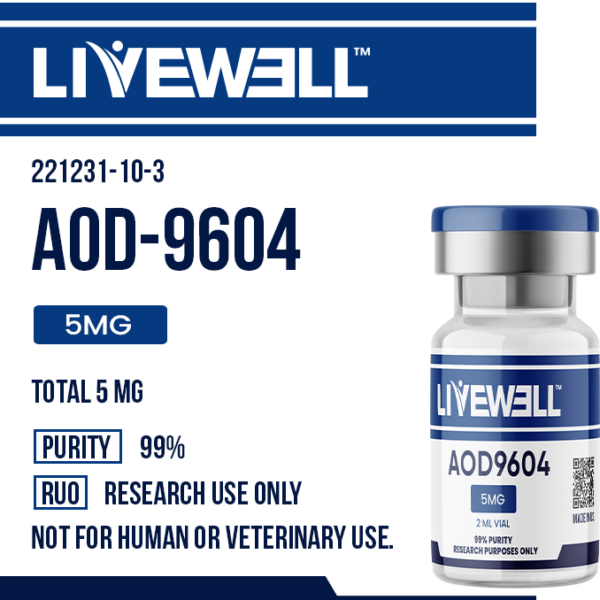
AOD-9604 Research Peptide
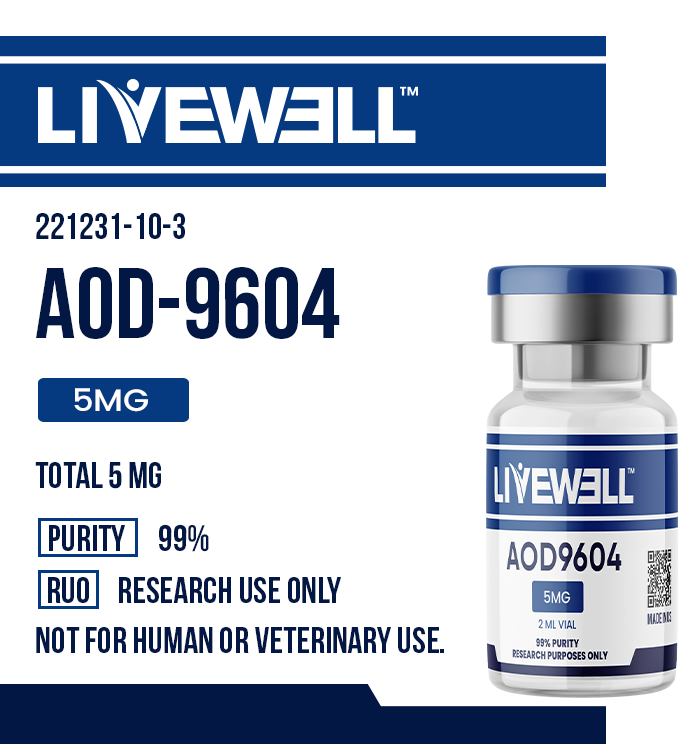
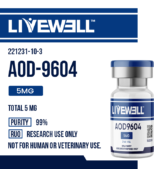
AOD-9604 is a 16-amino-acid synthetic peptide fragment corresponding to residues 176-191 of human growth hormone, with an N-terminal tyrosine addition for enzymatic stability. LiveWell supplies it as a lyophilized vial in 2 MG, 5 MG and 10 MG sizes, strictly for in-vitro laboratory research use only — it is not for human or animal consumption.
Structure: AOD-9604 corresponds to the C-terminal region of the hGH molecule. Because it represents only a fragment rather than the full-length hormone, it is examined in the literature as a structurally distinct research compound from hGH itself. Two cysteine residues in the sequence form an intramolecular disulfide bond, contributing to a conformationally constrained structure.
Chemical information
- CAS Number: 221231-10-3
- Sequence: Tyr-Leu-Arg-Ile-Val-Gln-Cys-Arg-Ser-Val-Glu-Gly-Ser-Cys-Gly-Phe
- Molecular formula: C78H123N23O23S2
- Molecular weight: approximately 1815.08 g/mol
- Sequence length: 16 amino acids
- Available sizes: 2 MG, 5 MG, 10 MG
Studied in
Comparative hGH-fragment research, adipocyte and lipid-pathway studies in cell culture, receptor-interaction analysis, enzymatic-stability characterisation, and structure-function comparisons against full-length growth hormone in controlled laboratory models.
Storage & handling
- Store the lyophilized powder at −20°C, desiccated and protected from light; for long-term storage, −80°C is preferred
- Reconstitute with bacteriostatic water
- After reconstitution, store at 2–8°C or aliquot and freeze; avoid repeated freeze-thaw cycles
- Follow your laboratory’s standard peptide handling protocol
⚠️ Disclaimer: AOD-9604 is intended strictly for laboratory research and in-vitro use only. It is not a drug, food, cosmetic, or dietary supplement. This product has not been evaluated or approved by the FDA and is not for human or animal use. It is not intended to diagnose, treat, cure or prevent any disease, and no therapeutic, weight-management, performance or physique claims are made or implied.
Buy AOD-9604 Research Peptide — cGMP Manufactured in Dallas, TX
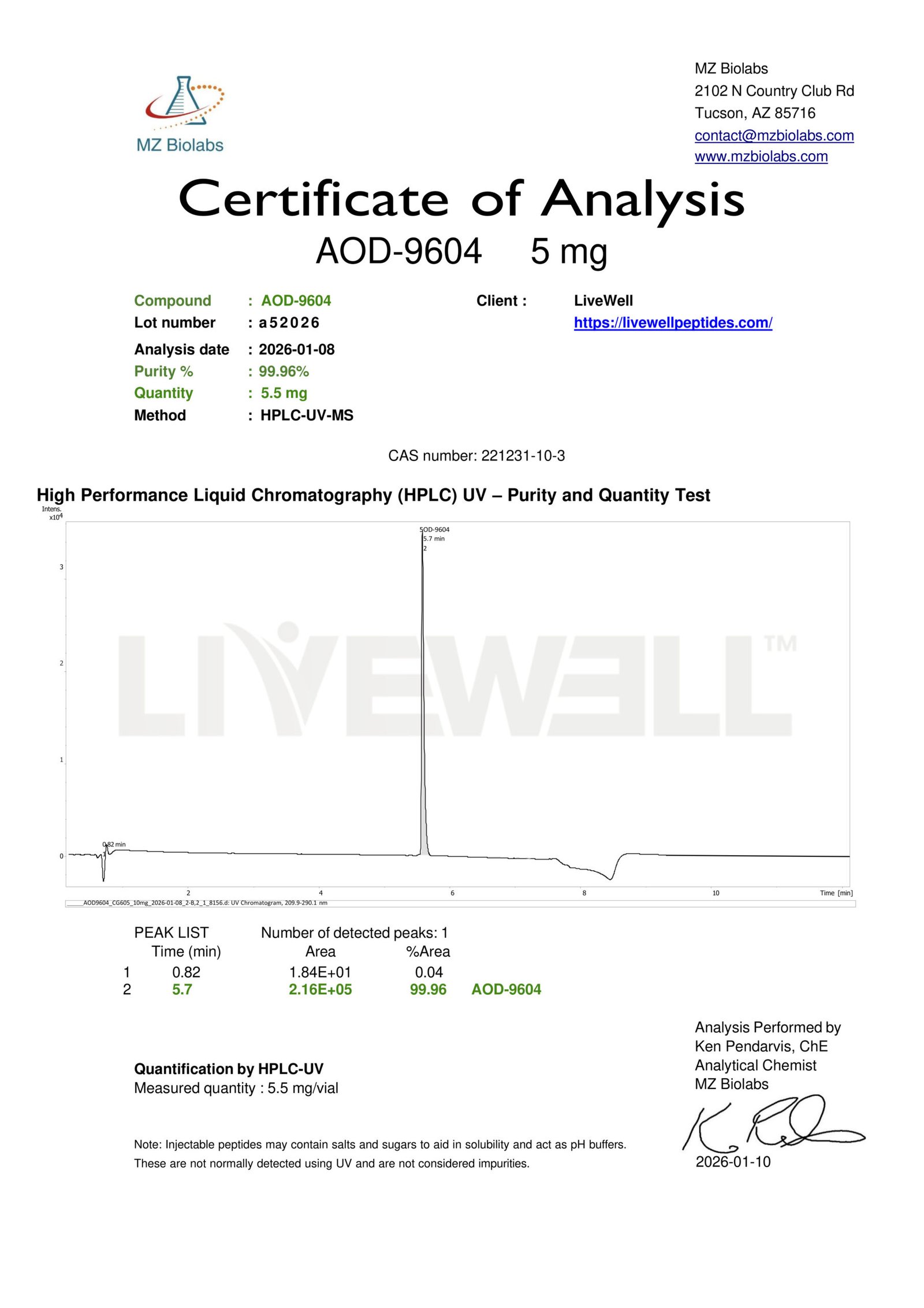
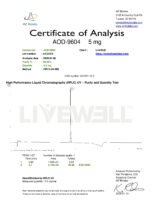
LiveWell Peptides manufactures research-grade AOD-9604 (hGH fragment 176-191) in our cGMP facility in Dallas, Texas. Every vial is third-party tested by independent laboratories to verify ≥99% HPLC purity, amino acid identity by mass spectrometry, and endotoxin limits by LAL testing, and ships with a batch-specific certificate of analysis published on our COA page.
Available in 2 MG, 5 MG and 10 MG vials, supplied as lyophilized powder for reconstitution. US orders placed before 2pm CT (Mon–Fri) ship same-day in cold-chain packaging, with free domestic shipping on orders over $200. International shipping is available. Sold strictly for research use only — not for human consumption.
Why Researchers Source AOD-9604 from LiveWell Peptides
LiveWell Peptides is a US-based cGMP peptide manufacturer headquartered in Dallas, Texas, supplying research-grade peptides to laboratories, universities and qualified independent researchers across the United States and internationally.
Documentation, not claims. Every batch of AOD-9604 ships with a verified certificate of analysis (COA) confirming identity and purity. COAs are published on our COA page rather than supplied only on request, because purity should be documented, not asserted.
Four-point analytical testing. Each lot is analysed by HPLC for purity, mass spectrometry for amino acid identity, and LAL testing for endotoxins, with independent third-party verification on top of in-house quality control.
US manufacturing and cold-chain logistics. Peptide stability depends on temperature control. Orders ship same-day from our Dallas, Texas facility in thermo-insulated packaging, with free domestic shipping over $200 and international shipping to Colombia, Mexico, Brazil, Argentina, Chile and Peru.
Bulk pricing and private label. Volume pricing applies automatically at checkout — 10% off at 3–5 units, 15% at 6–8, and 20% at 10 or more. For wholesale quantities or private label enquiries, contact our sales team.
Related research
5-Amino-1MQ · Sermorelin · IGF-1 LR3 · Bacteriostatic Water · All peptide vials · Certificates of Analysis
Frequently Asked Questions
What is AOD-9604?
AOD-9604 is a 16-amino-acid synthetic peptide fragment corresponding to residues 176-191 of human growth hormone (hGH), with an added N-terminal tyrosine. It is a structurally distinct C-terminal fragment rather than the full-length hormone, supplied as a lyophilized vial for laboratory research use only.
What is the chemical structure of AOD-9604?
AOD-9604 has the sequence Tyr-Leu-Arg-Ile-Val-Gln-Cys-Arg-Ser-Val-Glu-Gly-Ser-Cys-Gly-Phe, CAS 221231-10-3, molecular formula C78H123N23O23S2, and a molecular weight of approximately 1815.08 g/mol. Two cysteine residues form an intramolecular disulfide bond. Full documentation is included with each Certificate of Analysis.
What is AOD-9604 studied for in research?
It is examined in comparative hGH-fragment research, structure-function analysis against full-length growth hormone, receptor-interaction studies, enzymatic-stability characterisation, and adipocyte/lipid-pathway research in cell culture. LiveWell AOD-9604 is intended strictly for laboratory research use only.
What sizes are available?
AOD-9604 is supplied in 2 MG, 5 MG and 10 MG lyophilized vials.
What purity is LiveWell AOD-9604, and is a COA included?
Every batch is third-party tested at ≥99% purity by HPLC, with mass spectrometry identity confirmation and LAL endotoxin testing. A batch-specific Certificate of Analysis is included and published on our COA page.
How should AOD-9604 be stored and reconstituted?
Store the lyophilized powder at −20°C, desiccated and protected from light (−80°C for long-term storage). Reconstitute with bacteriostatic water; after reconstitution, store at 2–8°C or aliquot and freeze, avoiding repeated freeze-thaw cycles.
Is AOD-9604 a drug or supplement?
No. AOD-9604 is a research compound sold strictly for laboratory and research use only. It is not a drug, dietary supplement, food or cosmetic, and it is not intended for human or animal consumption.
Comprar AOD-9604 péptidos de investigación — fragmento de hGH 176-191 fabricado bajo estándares cGMP en Dallas, Texas. Certificado de análisis incluido. Envío internacional. Solo para uso en investigación.