

Peptide Research
Peptide Blueprint VOL2 Issue24 GLP-1 & Heart Health & Brain combine

PATH TO PEPTIDES GLP-1 AND YOUR HEART
WHAT A 2-MILLION-PATIENT STUDY REVEALED
A STUDY OF OVER 2 MILLION PATIENTS FOUND THAT GLP-1 DRUGS WERE LINKED TO LOWER RISK OF 42 DIFFERENT HEALTH CONDITIONS — INCLUDING HEART ATTACK, STROKE, AND HEART FAILURE.
Quick answer: A study of over 2 million patients found GLP-1 drugs were linked to a lower risk of 42 different health conditions, including heart attack, stroke, and heart failure. Researchers are now investigating whether these cardiovascular benefits extend to brain health outcomes as well.
Notably, that is not a typo. Indeed, medications originally designed to manage blood sugar are now at the center of one of the most exciting areas of heart research in years. Below, here is what the science shows — and why cardiologists are paying close attention.
WHY GLP-1 HEART HEALTH MATTERS
Today, heart disease is the leading cause of death worldwide. For instance, in the United States alone, someone has a heart attack every 40 seconds.1 However, despite decades of progress in treatments, heart disease still kills more Americans than cancer, accidents, and respiratory disease combined. Consequently, any medication that shows significant heart benefits gets serious attention from researchers. Moreover, GLP-1 drugs are delivering some of the most compelling cardiovascular data scientists have seen in years.
THE SCIENCE: HOW GLP-1 HEART HEALTH BENEFITS MAY WORK
Importantly, GLP-1 receptors are not just in your gut and brain. Specifically, they are also found in your heart and blood vessels.2 Essentially, think of GLP-1 receptors like locks on a door. When the right key (a GLP-1 drug) turns that lock, it triggers helpful changes inside the cell.
Furthermore, scientists believe GLP-1 drugs may protect the heart in several ways:
Reducing inflammation: Specifically, chronic inflammation damages blood vessels over time. In addition, research shows GLP-1 drugs lower key markers of inflammation throughout the body.3
Improving blood vessel function: Similarly, these drugs appear to help blood vessels relax and expand more easily, which improves blood flow and lowers blood pressure.4
Reducing arterial plaque: Early studies suggest GLP-1 drugs may slow the buildup of fatty deposits in arteries — the root cause of most heart attacks.5
Weight loss: Losing excess weight reduces strain on the heart. But researchers believe the heart benefits go beyond weight loss alone.6
Did You Know? In the landmark SELECT trial, semaglutide reduced major cardiovascular events by 20% in people with obesity — even those who did NOT have diabetes. That was the first time a weight loss drug showed this kind of heart protection.6
WHAT THE GLP-1 HEART HEALTH RESEARCH SAYS
THE SELECT TRIAL (2023)
This was the game-changer. Published in the New England Journal of Medicine, the SELECT trial studied over 17,600 adults with obesity and existing heart disease — but without diabetes.6
Participants who received semaglutide had a 20% lower risk of major heart events (heart attack, stroke, or cardiovascular death) compared to those on placebo. This finding led the FDA to approve semaglutide specifically for reducing cardiovascular risk in adults with obesity.7
THE SUMMIT TRIAL — HEART FAILURE (2024)
The SUMMIT trial, published in the New England Journal of Medicine in December 2024, studied tirzepatide in 731 patients with heart failure and obesity.8
Results showed tirzepatide reduced the combined risk of worsening heart failure or cardiovascular death by 38% compared to placebo. Participants also reported significant improvements in their ability to exercise and in their quality of life.
THE 2-MILLION-PATIENT STUDY (2024)
Published in Nature Medicine, this massive study analyzed electronic health records from over 2 million patients who had taken GLP-1 medications.9
The findings were striking: GLP-1 drug use was associated with reduced risk across 42 different conditions spanning 10 organ systems. Notably, heart-related benefits included lower rates of heart attack,stroke, heart failure, and atrial fibrillation.
KEY GLP-1 HEART HEALTH FINDINGS
| Study | Patients | Key Finding | Published |
|---|---|---|---|
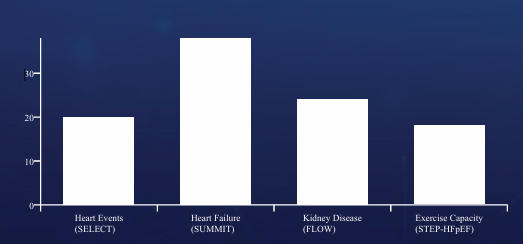
| SELECT | 17,604 | 20% lower major cardiovascular events | NEJM 2023 |
| SUMMIT | 731 | 38% lower worsening heart failure risk | NEJM 2024 |
| Nature Medicine Analysis | 2,000,000+ | 42 conditions with reduced risk | Nat Med 2024 |
| FLOW (kidney) | 3,533 | 24% lower kidney disease progression | NEJM 2024 |
| STEP-HFpEF | 529 | Improved exercise capacity + symptoms | NEJM 2023 |
RISK REDUCTION SEEN IN MAJOR GLP-1 CARDIOVASCULAR TRIALS (%)
THE BIG PICTURE: BEYOND GLP-1 HEART HEALTH
Ultimately, the cardiovascular findings are part of a bigger story. Notably, the 2-million-patient study found GLP-1 drugs were associated with benefits across nearly every organ system studied — including the
brain, kidneys, liver, and lungs.9
However, scientists are now debating whether GLP-1 drugs reduce disease risk only because they cause weight loss, or whether they have direct protective effects on organs. Growing evidence supports the
idea that both mechanisms are at work.10
As one researcher put it: these drugs may be doing something fundamentally important at the cellular level — reducing inflammation and stress in ways that protect multiple organs at once.
WHAT TO KNOW ABOUT GLP-1 HEART HEALTH
Key Takeaways:</strong
- GLP-1 drugs like semaglutide and tirzepatide show significant heart benefits in large trials.
- The SELECT trial led to the first FDA approval of a weight loss drug for heart protection.
- Benefits appear to go beyond weight loss — direct effects on blood vessels and inflammation may play a role.
- A study of 2M+ patients linked GLP-1 drugs to lower risk across 42 different health conditions.
- These are prescription medications — always work with your healthcare provider.
- Research is ongoing. Larger and longer studies will continue to
clarify these findings.
FREQUENTLY ASKED QUESTIONS ABOUT GLP-1 HEART HEALTH
What did the 2-million-patient study find about GLP-1 heart health?
Specifically, the Nature Medicine umbrella review of more than 2 million patients linked GLP-1 drugs to reduced risk across 42 different conditions spanning 10 organ systems. Notably, heart-related benefits included lower rates of heart attack, stroke, heart failure, and atrial fibrillation.
What did the SELECT trial show?
For example, SELECT enrolled 17,604 patients and found a 20% reduction in major cardiovascular events, published in the New England Journal of Medicine in 2023.
Do GLP-1 drugs help heart failure?
Similarly, the SUMMIT trial of 731 patients reported a 38% lower risk of worsening heart failure. In addition, STEP-HFpEF, with 529 patients, found improved exercise capacity and symptoms.
How might GLP-1 medications protect the heart?
Notably, GLP-1 receptors are found in the heart and blood vessels, not only the gut and brain. Specifically, proposed mechanisms include reducing chronic inflammation and improving blood vessel function, alongside weight and blood sugar effects.
Are GLP-1 heart health benefits only due to weight loss?
Currently, that is actively debated. Moreover, scientists are still working out how much benefit comes from weight loss versus direct effects on tissue. For general cardiovascular guidance see the National Heart, Lung, and Blood Institute, and for approved uses the FDA. This is educational information, not medical advice.
REFERENCES
1. American Heart Association. Heart Disease and Stroke Statistics — 2024 Update. Circulation. 2024;149(8):e347-e913.
2. Drucker DJ. The cardiovascular biology of glucagon-like peptide-1. Cell Metab. 2016;24(1):15-30.
3. Rakipovski G, et al. The GLP-1 analogs reduce atherosclerotic plaque in ApoE-deficient mice. J Am Coll Cardiol. 2018;72(7):785-796.
4. Nystrom T, et al. Effects of glucagon-like peptide-1 on endothelial function. Am J Physiol Endocrinol Metab. 2004;286(6):E918-E922.
5. Marso SP, et al. Liraglutide and cardiovascular outcomes in type 2 diabetes. N Engl J Med. 2016;375(4):311-322.
6. Lincoff AM, et al. Semaglutide and cardiovascular outcomes in obesity without diabetes. N Engl J Med. 2023;389(24):2221-2232.
7. FDA. FDA approves first treatment to reduce risk of serious heart problems specifically in adults with obesity. March 2024.
8. Packer M, et al. Tirzepatide for heart failure with preserved ejection fraction and obesity. N Engl J Med. 2024;391(25):2379-2389.
9. Wang W, et al. GLP-1 receptor agonists and health outcomes: umbrella review of 2 million patients. Nature Medicine. 2024.
10. Sattar N, et al. GLP-1 receptor agonists: cardiovascular benefits beyond glucose and weight. Lancet Diabetes Endocrinol. 2024;12(1):39-47.
FOR RESEARCH AND EDUCATIONAL PURPOSES ONLY
This document is intended solely for educational purposes to increase awareness of emerging scientific research. It does not constitute medical advice and should not be used to make healthcare decisions.
Regulatory Status: Semaglutide (Ozempic/Wegovy) and tirzepatide (Mounjaro/Zepbound) are FDA-approved for type 2 diabetes and/or chronic weight management. Semaglutide (Wegovy) is FDA-approved to reduce cardiovascular risk in adults with obesity. Other cardiovascular applications described in this document are based on published research and may not yet be reflected in FDA-approved labeling.
All healthcare decisions should be made in consultation with qualified medical professionals.
This publication is part of an ongoing educational series designed to promote scientific literacy and awareness of developments in health research.